Archives
-

Journal of Urban Systems and Innovations for Resilience in Zimbabwe
Vol. 5 No. 1 (2023)The purpose of the Journal of Urban Systems and Innovations for Resilience in Zimbabwe (JUSIRZ) is to provide a forum for urban solutions based on systems approach and thinking as the bedrock of intervention.
-

Journal of Urban Systems and Innovations for Resilience in Zimbabwe
Vol. 2 No. 1 (2020)The purpose of the Journal of Urban Systems and Innovations for Resilience in Zimbabwe (JUSIRZ) is to provide a forum for urban solutions basing on systems approach and thinking as the bedrock of intervention
-

Journal of Urban Systems and Innovations for Resilience in Zimbabwe
Vol. 1 No. 1& 2 (2019)It is generally becoming increasingly and abundantly clear that the future of Zimbabwe like anywhere global, is urban. Rural business centres and growth points are clearly shaping into urban centres owing to growing urbanization. As such, as these ‘rural towns’ are joining the league of centres traditionally
deemed as urban, and defined as so by the Urban Councils Act (Chapter 29:15) the thinking and drive for search of solutions must definitely be urban. Urban centres are complex in terms of planning and management due to various phenomena and inputs that define their makeup and maintenance. On the environmental front, pollution abatement is a serious challenge so as the provision of potable water and amenable sanitation. On the social side, provision of services including health, education and recreation are better crafted at planning state. On the economic side, the challenge of the youth bulge hence, employment creation, poverty reduction and livelihoods enhancement come at the core. Besides, sprawling urban centres are not only difficulty to coordinate but also uneconomic to manage. Subdivision
and consolidations have to be carefully planned and managed. In certain circumstances, densification has to be considered as a principal good in addressing the challenge of sprawl. Urban systems are a constellation of social, economic, political, institutional and legal forces, usually all working simultaneously in a complex of reality. From time to time, solutions must be thought of and even incubated into innovations, in this case, for water supply, traffic management, building management, urban planning, civil engineering, to mention but a few. Missing locally is a journal that becomes a forum by both professional and academic contributors to discuss urban systems and innovations in Zimbabwe. As such the Journal of Urban Systems and Innovations for Resilience in Zimbabwe (JUSIR IZ) is hereby proposed. -
Journal of Urban Systems and Innovations fro Resilience in Zimbabwe
Vol. 3 No. 2 (2021)The purpose of the Journal of Urban Systems and Innovations for Resilience in Zimbabwe (JUSIRZ) is to provide a forum for urban solutions basing on systems approach and thinking as the bedrock of intervention.
-

Journal of Urban Systems and Innovations for Resilience in Zimbabwe
Vol. 4 No. 2 (2022)2022 Special Issue 1: Land and Housing Precarity in Zimbabwe's Emerging Settlements, supported through the Inclusive Urban Infrastructure research project funded by UK Research and Innovations (UKRI), Global Challenges Research Fund under the title Towards Trajectories of Inclusion: Making infrastructure work for the most marginalised (Grant reference number ES/T008067/1)
-
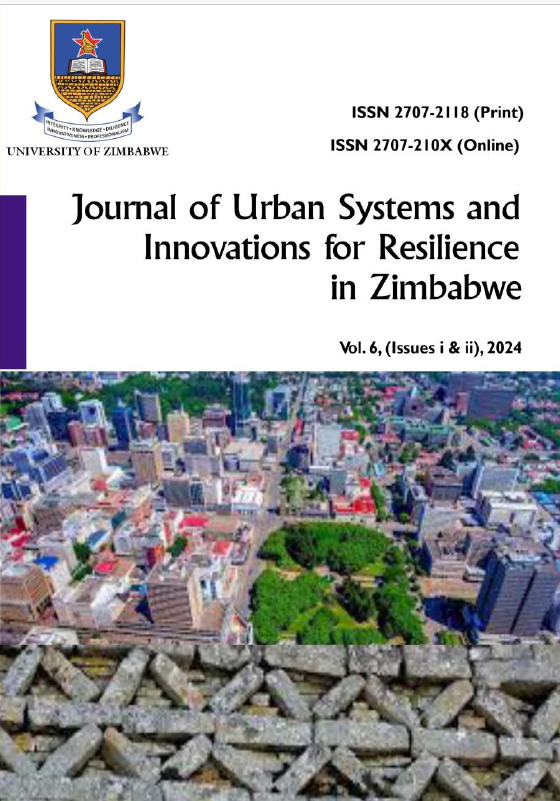
Journal of Urban Systems and Innovations for Resilience in Zimbabwe
Vol. 6 No. 1 (2024)Volume 6 (Issues 1 and 2) responds to entrenched policy challenges in the pursuit of resilient urban communities across Zimbabwe‘s secondary cities and towns. Amidst macroeconomic turbulence characterised by hyperinflation, currency instability and fiscal austerity, urban areas increasingly confront gender-insensitive interventions that exacerbate vulnerabilities among women and marginalised groups. These challenges are compounded by a weakened civic culture that limits meaningful participation. Resource constraints, reflected in underfunded municipal budgets and infrastructural backlogs further heighten vulnerability to floods, economic shocks and social fragmentation. This is particularly shown in mining-dependent settlements such as Zvishavane and rapidly expanding peri-urban areas like Ruwa.
This double Issue aligns with global policy frameworks, including the UN-Habitat World Cities Report 2024 and Sustainable Development Goal 11, while resonating with regional priorities articulated in the African Union Agenda 2063 and the Southern African Development Community (SADC) Climate Change Adaptation Protocols. By focusing on often-overlooked urban peripheries beyond Harare, the Volume adopts a transdisciplinary perspective that draws on urban planning, environmental economics, spatial justice and resilience engineering to examine extractive legacies and urban retrofitting processes. Addressing empirical gaps in post-mining transitions and flood-prone hydrological systems, the Volume mobilises evidence from case studies in Zvishavane, Harare‘s suburbs, the Ruwa catchment and emerging growth points such as Nyika in Bikita District, Zimbabwe.
The contributions collectively examine interconnected policy challenges, grounded in empirical analyses of Zimbabwe‘s urban–rural interface. Amodelling. In mining contexts, the Zvishavane case advances a ‗Mine Urban Resilience Framework‘ that promotes rent-to-buy housing schemes, adaptive reuse of infrastructure and legislative reforms enabling revenue cross-subsidisation through land value capture. In suburban contexts, the revitalisation of High Glen is conceptualised through hybrid public–private partnerships (PPPs), incorporating mixed-use development models, flexible rental structures and tenant clustering strategies to address voids and shifting retail dynamics. Flood risk mitigation is strengthened through GIS-based modelling approaches applied in the Ruwa catchment, integrating CHIRPS rainfall data, SRTM digital elevation models and composite susceptibility indices to delineate planning buffers and inform metropolitan-scale interventions. Gender-responsive water governance is advanced through participatory approaches that foreground women‘s leadership in borehole management and decision-making processes. In Caledonia, innovative regularisation strategies combine tenure security; infrastructure planning and stakeholder co-production to support transitions from informal to formal settlement structures. Meanwhile, the retrofitting of growth points such as Nyika demonstrates the potential of DPSIR-informed smart interventions, including solar technologies, sensor-based metering, digital twin systems and community-based environmental monitoring platforms, to foster low-carbon and adaptive development pathways.
Collectively, these contributions articulate transformative policy imperatives for both central and local government: embedding spatial justice in post-mining governance; revitalising suburban economies through adaptive Public-Private Partnership (PPP) frameworks; operationalising flood resilience through data-driven planning; advancing gender-inclusive water and housing governance and promoting sustainable retrofitting in emerging rural settlements. In the context of intensifying climate and economic uncertainties, the Volume calls upon Zimbabwean policymakers, planners and stakeholders to harness these insights in shaping inclusive and adaptive urban futures underscoring the fact that equitable, contextually grounded planning, rather than extractive economic models alone, forms the foundation of resilient and thriving human settlements. -

Journal of Urban Systems and Innovations for Resilience in Zimbabwe
Vol. 2 No. 2 (2020)This journal issue prompts that action be undertaken following the roadmap by addressing specific challenges with a compilation of articles on the water dilemmas faced in our cities. It offers solutions based on research and innovative thinking to address the multiple challenges faced by urban citizens, including topics on water-sensitive urban designs, safety and hygiene in the informal sector, implications of WASH on urban planning, wetland functions, environmental hygiene during COVID-19, and specialised methods to advance urban agriculture.
We hope that through these contributions, urban sector stakeholders can further explore the plethora of options to make cities better places for current and future generations.
-

Journal of Urban Systems and Innovations for Resilience in Zimbabwe
Vol. 3 No. 1 (2021)The purpose of the Journal of Urban Systems and Innovations for Resilience in Zimbabwe (JUSIRZ) is to provide a forum for urban solutions based on a systems approach and thinking as the bedrock of intervention.
-

Journal of Urban Systems and Innovations for Resilience in Zimbabwe
Vol. 4 No. 1 (2022)The journal is a forum for the discussion of ideas, scholarly
opinions and case studies of urban resilience in Zimbabwe. It
promotes multidisciplinary engagement of urban resilience as a
subject and practice. It is a product of the Department of
Architecture & Real Estate and the Department of Demography
Settlement & Development at the University of Zimbabwe
supported by the UNDP–UNICEF Urban Resilience
Programme. The journal is produced bi-annually.